Continuing Education, Continuing Medical Education, Customization, Edupreneurs, eLearning, eLearning As A Business, Professional Training
Why Branding Your eLearning Business Is About More Than Just Your Logo
Your company’s brand is both tangible and intangible. It includes such concrete things as your logo, website, marketing efforts, the products you offer and (whether sent physically or electronically) the packaging they arrive in when delivered to your customers. However, the perception of your company’s brand also extends to such impalpable (and hard to measure) things as the quality of your customer support, your day-to-day interaction with customers and even your tone in an email. In other words, the collective experience of your company by those external to it is the definition of your company’s brand. When looking to strengthen company branding, it is important to note that the more tangible aspects of your company’s brand are low hanging fruit that can be more easily optimized, whereas the intangible aspects that contribute to company branding can be more challenging to improve.
Tangible aspects of company branding
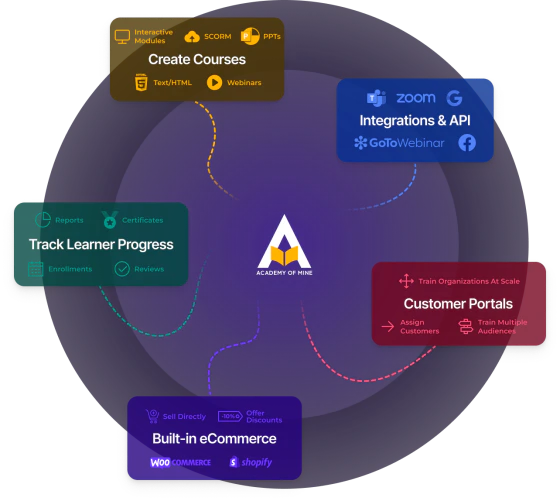
For those in the eLearning industry, it goes without saying that you rely on the functionality of your learning management system as the foundation of your business and a key component of your company’s brand. We’re frequently asked by prospective clients: How can an LMS be customized to follow company branding?
<
div>
Intangible aspects of company branding
As a general rule of thumb that can be applied to any industry, the better the user experience a customer has with a company (or platform) the more likely they are to return and bring their repeat business (read: money) as well as recommend the service or product to other prospective customers (word of mouth referral is the best advertising, after all). And of course, strengthen their perception of your company’s brand.The importance of your customers having a high quality user experience (and how that affects your ROI and ultimately your long term brand) is no different whether applying it to real-life interactions with clients and company personnel or a customer’s experience while [using] your LMS.
However, as a business owner with a product you are selling (your online courses) that are taken (experienced) via your LMS, keep in mind that it is still important to remember that your students’ user experience is more than just your LMS and its UX design and extends into areas that are not as easily measured.
Your student’s overall user experience can be broken out into three parts:
- Student’s user experience while in your LMS. A platform’s intuitive interface and ease-of-use absolutely is the central component and primary driving force behind students’ general user experience.
- Student’s user experience while interacting with you. Are you available to your students? Is contact with your easily accessible or are you challenging to get a hold of? Be sure to remember that your brand and company always extends to you, and that your communication style and availability always has a direct impact on your customers’ user experience.
- Student’s user experience with your platform vendor (if your vendor offers that level of student support). If your platform provider offers direct to support to students keep in mind that your vendor’s quality of customer service also impacts students’ user experience, especially since we only reach out to support after something is wrong and likely are already frustrated.
We recommend keeping the big picture in mind when assessing your students’ user experience, and remember it always more than just your LMS.